CUOCP® Exam Structure & Domains
Exam Focus
The examination emphasizes:
Applied decision-making under real constraints
Risk-informed judgment
Cross-functional coordination
Ethical accountability and professional responsibility
This is not a rote knowledge or attendance-based assessment. The examination assumes prior professional experience and evaluates how candidates reason, prioritize, and decide under pressure.
NACUP provides CUOCP® preparation modules to define the professional standard and expectations evaluated on the examination. Completion of modules supports alignment to the standard; certification is awarded based solely on examination performance.
Section 1: Exam Architecture
Assessing applied leadership judgment in utility operations and capital environments
The CUOCP® examination evaluates real-world professional judgment required in regulated, safety-critical utility and capital environments.
Exam Format
Secure, third-party proctored examination through Honorlock
Computer-based delivery
Combination of multiple-choice and scenario-based questions
Scenarios reflect operational, capital, safety, risk, regulatory, accountability and leadership decision-making contexts
Section 2: Exam Length & Structure
Exam Length & Timing
Total questions: 120
Exam duration: 3 hours
Question Structure
Scenario-driven questions may include:
Operational disruptions
Capital project tradeoffs
Safety or compliance dilemmas
Contractor or workforce issues
Budget, schedule, or regulatory pressure
Candidates are evaluated on judgment quality, not speed.
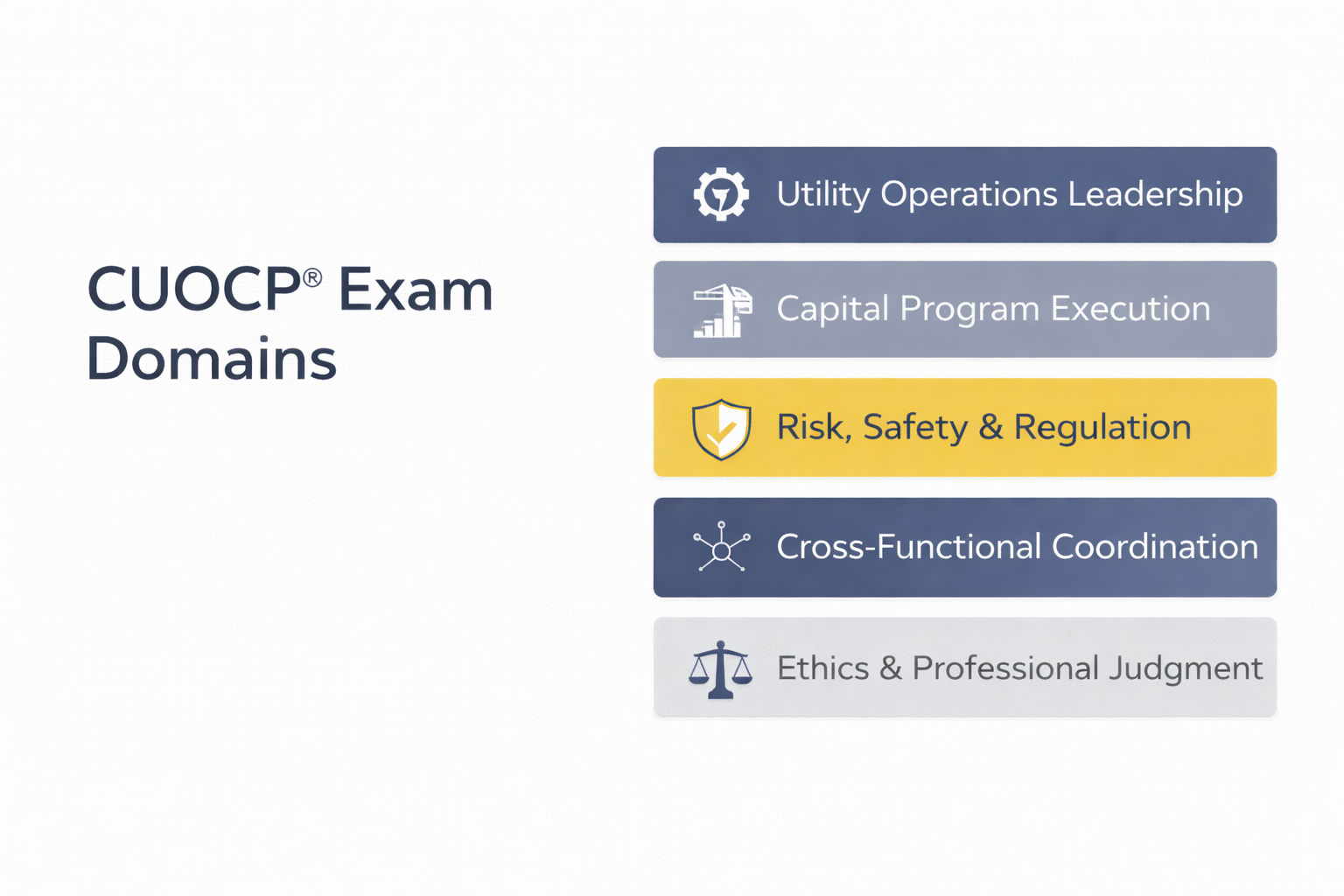
1. Utility Operations Leadership — 30%
This domain assesses leadership judgment in day-to-day utility operations.
Includes evaluation of:
Operational decision-making in safety-critical environments
Managing reliability, outages, and performance under constraints
Workforce leadership, supervision, and accountability
Emergency prepardness opertion priorities
Balancing operational priorities with regulatory and public expectations
This domain reflects the core leadership responsibilities of utility operations professionals.
2. Capital Program Execution & Oversight — 25%
This domain evaluates oversight and governance of capital programs and projects.
Includes evaluation of:
Capital planning and prioritization
Project execution oversight (schedule, cost, scope, risk)
Contractor and vendor management
Governance, controls, and accountability across capital portfolios
Focus is placed on oversight and judgment, not technical design.
3. Risk, Safety, and Regulatory Decision-Making — 20%
This domain measures how candidates assess and manage risk in regulated environments.
Includes evaluation of:
Safety leadership and risk mitigation
Compliance decision-making
Navigating regulatory obligations and audits
Responding to incidents, near-misses, or enforcement scenarios
Candidates are evaluated on their ability to protect public safety, infrastructure, and trust.
4. Cross-Functional Coordination & Contractor Oversight — 15%
This domain focuses on leadership across organizational boundaries.
Includes evaluation of:
Coordinating engineering, operations, safety, and regulatory functions
Managing external contractors and partners
Resolving cross-functional conflicts
Ensuring alignment and accountability across teams
This reflects the reality that utility leaders rarely operate in silos.
5. Ethics, Accountability, and Professional Judgment — 10%
This domain evaluates ethical leadership and professional responsibility.
Includes evaluation of:
Ethical decision-making under pressure
Conflict-of-interest awareness
Transparency and accountability
Upholding professional standards and public trust
This domain reinforces that credibility and integrity are foundational, not optional.
Section 3: Exam Domains & Weightings
Together, these domains reflect the full leadership responsibility held by utility and capital professionals, from daily operations through enterprise-level accountability.
(Percentages may be refined over time to reflect industry evolution.)
Section 4: Scoring & Performance Standards
Scoring Overview
The CUOCP® exam is scored using a psychometrically sound methodology
Candidates must demonstrate overall competence across domains
Passing standards are set to reflect professional readiness, not relative ranking
NACUP does not disclose individual questions, answers, or scoring algorithms to protect exam integrity.
Section 5: What the Exam Is and Is Not
What the CUOCP® Exam Is
An independent, exam-based professional assessment
A benchmark of applied leadership readiness in utility operations and capital environments
A validation of professional judgment, accountability, and decision-making under pressure
What the CUOCP® Exam Is Not
A course-completion or attendance-based credential
A memorization-based test
A vendor- or employer-specific certification
Preparation resources support readiness; certification is awarded solely through demonstrated performance on the examination.
Section 6: Next Steps
Candidates are encouraged to review:
Eligibility Requirements
Examination Policies & Procedures
Testing & Proctoring Information
Enrollment is available once eligibility is confirmed.
Ready to proceed?
Review eligibility requirements and examination policies before enrollment.
Exam content and structure questions: support@nacup.org