
Exam-Based vs Attendance-Based Utility Credentials
Introduction
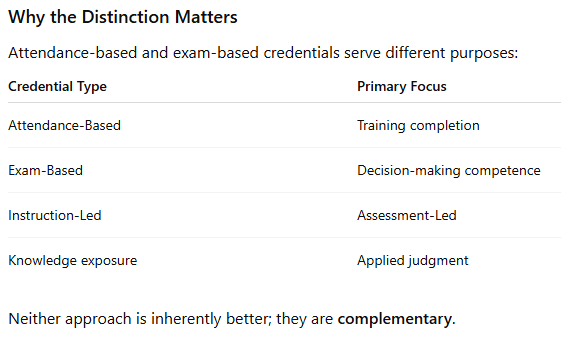
Not all certifications are designed to measure the same type of competence. In the utility sector, credentials generally fall into two broad categories: attendance-based credentials and exam-based credentials.
This page explains the differences between these approaches and when each is appropriate.
Exam-Based Credentials
Exam-based credentials rely on:
Independent assessment
Scenario-based questions
Demonstrated reasoning and prioritization
They are commonly used in professions where:
Decisions carry public risk
Leadership judgment matters as much as technical skill
Accountability extends beyond individual tasks
In utilities, exam-based credentials are less common but increasingly relevant as systems grow more complex.
Attendance-Based Credentials
Attendance-based credentials typically require:
Completion of a training course or series of modules
Participation in instruction or workshops
Sometimes a short knowledge check
These credentials are effective for:
Training delivery
Regulatory refreshers
Knowledge transfer
Skill development
They confirm exposure to material, not necessarily how that material is applied under pressure.
CUOCP as an Exam-Based Example
The CUOCP® credential uses an exam-based framework to evaluate how utility professionals:
Balance operations and capital priorities
Manage risk and regulatory pressure
Coordinate across functions
Exercise ethical and accountable leadership
It is intentionally positioned alongside, not instead of, traditional training and certification pathways.
Summary
Understanding the difference between attendance-based and exam-based credentials helps professionals and organizations select the right tools for development, validation, and accountability.
As leadership expectations rise across the utility sector, both credential types will continue to play important, but distinct roles.